
What Shooting in Zimbabwe Taught Me About Light

The flight from Heathrow to Harare is just over ten hours. I've made it several times now, and the experience never quite normalises. You leave a country where overcast skies are the default, where the light in November is thin and lateral and forces you to work hard for it, and you arrive somewhere where the sun at nine in the morning already has weight. It lands on surfaces differently. It carves shadows that don't exist in the same way at 50 degrees north. The first time I stepped off a plane in Zimbabwe with a camera in my bag, I spent the first two days shooting almost nothing useful because I hadn't adjusted my thinking fast enough.
Since then, the trips have been for two reasons: to oversee operations in the gold mining and hemp production work I'm involved in there, and to shoot. The two aren't as separate as they might sound. Both require you to look carefully at what's actually in front of you rather than what you expected to find.
The Quality of African Light
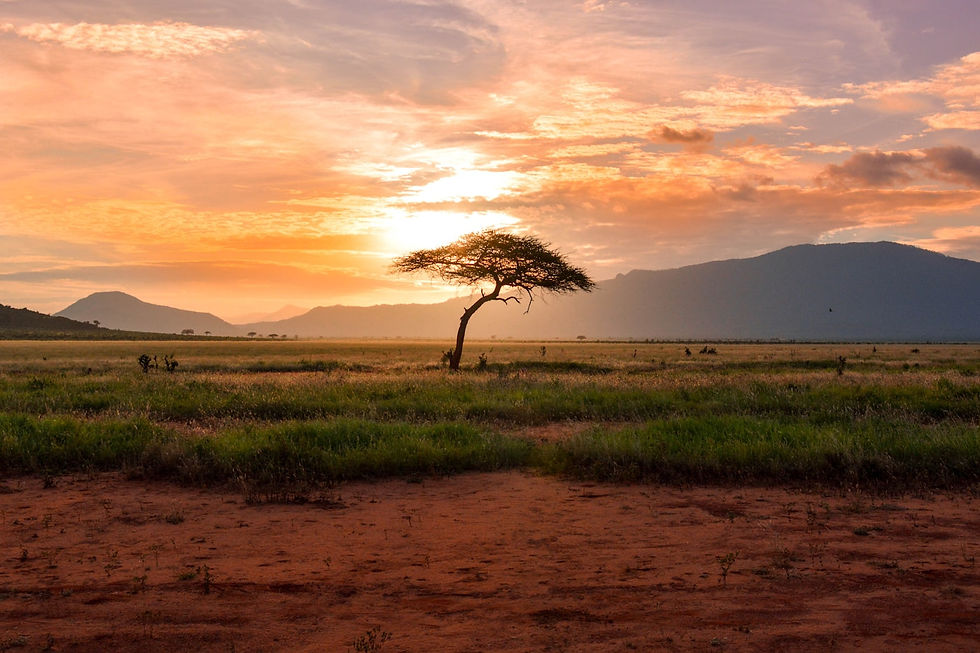
Photographers talk about golden hour the way other people talk about weather — it's a constant reference point, a shared language, a shorthand for 'the light is doing something beautiful right now.' In the UK, golden hour is precious partly because it's brief and partly because it often doesn't fully materialise. Cloud cover, humidity, the low angle of the sun in winter — these conspire regularly against you. In Zimbabwe, golden hour is a different animal entirely. The sun drops through clear air, and the light that hits a landscape or a face in those last forty minutes before dusk has a warmth and directionality that makes everything look like it was composed. Skin tones, textures, distances — all of it reveals itself.
What the Midday Light Teaches You
European photographers are conditioned to avoid midday light. The advice is standard: shoot early, shoot late, wait for the golden hours, use reflectors and diffusers if you must work in harsh conditions. In Zimbabwe, if you want to shoot the land and the people who work it, midday light is unavoidable. The choice is between not shooting, or learning to work with it.
What harsh overhead light does, if you stop fighting it, is reveal form. It strips away the flattery of soft light and shows you structure, texture, and truth. A portrait shot at noon in direct equatorial sun is confrontational. The shadows under eyes and cheekbones are deep. The highlights on foreheads and shoulders are bright. It requires a different kind of subject — someone whose presence holds up under scrutiny — and a different compositional approach. I started seeking shade that created natural fill rather than avoiding the sun altogether. A tree canopy with gaps. The shadow side of a building with enough reflected light from the ground to open up the face. The lesson was about finding structure within difficulty rather than around it.
The Gear Choices I Made
Shooting in high heat and dust requires thinking carefully about what you carry. I travel with the Sony A7R V as primary and the Fujifilm X-T5 as secondary — the combination covers both the high-resolution commercial work and the more intuitive, lighter documentary shooting that makes sense when you're moving through working environments.
Dust is the main adversarial factor. Both bodies have weather sealing, but lens changes in dusty environments are still a risk. My solution in the field has been to shoot each body with a fixed lens for entire sessions rather than switching — a 35mm on the Sony for wider environmental context, a 56mm equivalent on the Fujifilm for portraits. The constraint shapes the work in ways that end up feeling intentional rather than limiting.
How It Changed My Work Back in Cornwall
The effect of working in radically different light conditions is that you stop making assumptions. Cornwall's overcast light — which I used to think of as difficult — became something I started to see as an enormous, even diffuser. A cloudy day in Cornwall is a softbox the size of the sky. Once you've spent time fighting for light that doesn't cooperate, light that does cooperate feels like a gift.
Shooting across two very different environments, with the operational and logistical demands that come alongside the photographic ones, compressed a kind of experience that would have taken longer to accumulate working in a single location. The best photography education I've received hasn't come from courses or workshops. It's come from being somewhere unfamiliar with a camera and being forced to figure it out.
Comments